Tuesday, February 12, 2013

WWI: Schenck v. U.S.

Mr. Spencer
Image of Charles Schenck
ICivics
Image of the start of the Constitution
Dipity
Chief Justice, Mr. Oliver Holmes
The Free Dictionary
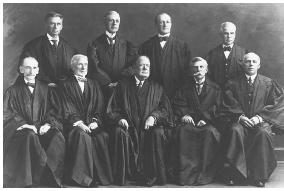
Image of the Justices

Schenck vs. U.S.

Throughout history many instances have taken place that may appear to be unconstitutional but are they? In 1919, in the midst of World War 1, a case to be remembered for generations to come came to the United States. Charles Schenck was the Secretary of the Socialist Party of America. He was responsible for printing, distributing, and mailing possible leaflets to prospective draftees. In the years of WWI, America had passed many laws that dealt with the freedom of Speech: Espionage, Sedition, and Sabotage. Through these amendments, the government had outlawed the use of speech as an engine against the military matters of the US. However Schenck believed that it was the duty of man to fight and support his rights. Schenck sent 15,000 pamphlets advocating the draftees to go against the war. The question that arose through this scenario was whether or not this was constitutional. How did the outcome of this case affect America during WWI, after WWI, and present day?
The case was pretty heated to say the least. It started in a local court in Philly, sooner than later it ended up in the hands of the Supreme Court. The constitution states that we as citizens/residents of the United States have the freedom to say whatever we want, it doesn't matter when or where. In 1917, the Constitution was slightly bent to say the least. Congress in that year passed the Espionage Act, which made it a crime to cause and attempt insubordination, disloyalty, mutiny, or refusal of duty in the military forces of the United States. The government what Schenck was doing, he was sending documents to draftees to oppose the draft and not submit to insubordination. Humans have the power of free will and that is something that can't be taken from you. I have the will to break this computer if I want, because it is mine. However are we owned by the government is a valid question. Does the government have the right to control what we do in our every day lives. The answer to that question is yes. We have entrusted officials from our local area to the president to choose things in our best interest. In that day and age, the government saw it efficient that the people be drafted in the military so they can protect the lives of many citizens who were living safe and sound across the country. What Schenck did was cause an obstacle which was against the law. The government saw in order to keep this country safe and running, in needed to pass such an act. What Schenck did was create a blockade between freedom of speech and the rights of officials. The country may have been split on WWI, but it did what it could in order to prevent a national disaster. Many protests took place across the country in retaliation to the conviction of Mr. Schenck. Many had come to the US from Europe in the past 25-30 years feeling the sense they had the freedom of doing whatever they wanted. They found it kind of oxymoronish that this 'God-given' right was taken from them. The national outrage caused by the opinion of the court set many to flames, however whatever the government did was clearly justified.
After World War I many things took place across the country such as the Great Depression, later on World War II, and more recently the Cold War. Freedom of Speech has been a centerpiece of the American ideal. People here believe that they have the right to believe whatever their heart desires, or lack thereof. The Cold War had much effect on Freedom of Speech. As we know that was a time of great struggle and frustration between America and Russia. The opinion of the court in this case was very interesting: "A nation at war is justified in taking steps to insure the success of its effort to defend itself." This is true whether the country is in a time of stress or not. We as humans have a right to think whatever we want, but we should be careful of what we say or publish. The government has rights upon us just like we have rights upon such an organization. Schenck found it safe to think in Socialist ideals, and we shouldn't have a problem, but what he did was put those outrageous ideas in action through using paper and mouth. The United States had a huge depression in the 20's where we saw the trend of the poor getting poorer and rich getting richer. The people who lived below the poverty line had a right to make the rich feel bad but they needed to know the consequences they faced in order to do so. They might have suffered being beaten, tortured, and even killed because they said specific things. Justified? Probably not! But freedom of speech does have limits. Freedom of Speech was forever affected by the Schenck vs. U.S. case. Even though it is a right for you to say whatever the heck you want, sometimes being quiet is the way to roll. Like they say, the scholars keep their mouth shut.
Present day we have to be very controlled of what we put out on social media outlets, the internet, and even by mouth. Schenck showed that in a time of war a government can and should do whatever they want and need in order to be in the best position to succeed. War puts a restriction on freedom of speech, well at least in public. Schenck served six months in prison after he was convicted, because his ideals were outrageous in the eyes of Chief Justice Holmes. We have the right of free speech until or unless there is clear and present danger provided through that speech. Many people today get a little to happy in their ideals and go and speak out against the ideals that the government has set forth. The decision had been made in 1917 in the Espionage Act that if you said or did anything against the army you would suffer the consequences. Present day many laws are being and will be passed that might limit your rights. But Schenck showed the government is the ultimate authority of the land and you will be responsible for your actions. Don't always do what your heart desires, rather do what is in the best interest of man!
Schenck made a mistake and paid the price. Freedom of speech is limited by many things, but you should say what ever you want as long as it does not put out a clear danged. The Schenck case made an immediate affect on WWI, the time after, and present day. Schenck taught some valuable lessons in Freedom of Speech and I hope everyone can learn from them.


Hyperlinks for WWI Project

Library of Congress - gave insight on the Espionage Act and its relation with Colonel Roosevelt and Mr. Hearth, a postmaster (primary source) (The Washington Times, May 20, 1918)
EBSCOHost - Used information to get results from the court case and see what the Justice, Mr. Holmes delievered to the court (primary source) (AVL, Supreme Court of United States, Nos. 437, 438)
The Supreme Court and Individual Rights (Book) - used information from a short section in the book in order to get information regarding why the government did what they did and what was the basis for finding it against "freedom of speech" to up rise against the war (David Savage, 2004)
Anchorage School District - got information on arguments made on either side about what was constitutional and what was not
Northwestern - gave information about the Socialist party and what they wanted the nation to do in the respect of WWI. Gave insight to what rights that people had and what their roles were. It gave more information on Schenck . (Oct 28, 1997, Jean Goodwin)
Huntingdon - brief power-point made by a professor at the university that includes many facts and circumstances about the case


Monday, January 14, 2013

Postcard Project

Today I continued researching on my postcard project. I found some really interesting articles through using the AVL service. I found some articles wrote by David Winkley describing the events and routes the fleet took on their journey around the world. I have also decided on the pictures on the postcards and I have chosen the places that they will go. I decided the places to be: Jamestown, around the horn of South Africa, Egypt, Japan, Hawaii, California. I have also decided my man to be an average sailor on the ship in his early twenties. He is from Atlanta, Georgia and he has three younger brothers and is from a single mother family. He is collecting souvenirs along the whole trip and he finds some amazing stuff. I look forward to completing this project!


Monday, November 19, 2012

Coca-Cola: Up, Up, & Away - Urbanization


John Pemberton
University of Southern Georgia
Coca-Cola Ad
Michigan State

    Throughout time many changes have taken place to make cities what they are today. One of the most important changes in my opinion was the invention of the soft fountain drink known today as Coca-Cola. John Pemberton, originally a pharmacist, opened the company known as Coca-Cola in 1881 after failing to create successful medications. He did this after moving to Atlanta and seeing advantages in the beverage market. Even though John Pemberton had created a phenomenon, he never got to really see what affect Coca-Cola would have on society, and specifically urban life. Mr. Pemberton had no idea how to advertise, so he gave that task to Frank Robinson. Frank Robinson you could say is what got Coca-cola to what it is today. Robinson not only registered the formula with the patent office and designed a logo that is used to this day, but also he made a slogan that caught many consumer's eyes: "The pause that refreshes."
Asa Griggs Candler
Governor's State
Coca-Cola Factory
Blairsville, PA
Indiana University of Pennsylvania

    After Pemberton's death in 1889, they company seemed it was gone and going to fail. At that point a man named Asa Griggs Chandler took over, buying the company for about $2300, equivalent to about $70,000 today. He was made the sole owner of the company and made some changes that would make Coca-Cola from selling 9 glasses a day to tens of thousands of glasses an hour. Mr. Chandler was very fond of advertising and you can see it if you look around this page, or just Google search Coca-Cola advertisement 1900s. You see these amazing advertisements that were found in everyday newspapers, magazines, calendars, and many other things. Not only making it a successful drink, Chandler tried to put it in the medicine market, saying it removes fatigue and cures headaches. Coca-cola, unfortunately wasn't a successful medication, ending in 1898 after a tax had been put on medications following the Spanish-American War. I have to admit though, I appreciate some coke whenever I am getting tired or my mind is aching.
Coca-Cola Bar
Wilkes Community College
Coca Cola Urn/Dispenser
Smithsonian

     What did coke provide to city life is a question that was raised as I did much research on this project. Coke did something that I believe no one at the time, or now could. It provided a cheap drink that not only pleased but also refreshed the body. People usually see an increase in quality correlates with an increase in price, but that was not the case with Coca-Cola. Coke started bottling in 1894  when a Mississippi salesman  named Joseph Biedenharm suggested the idea. Chandler, the owner of the company, wasn't too fond of it and only wanted to see coke as a fountain drink, but as we see today it proved to be wrong. I honestly like the taste of fountain drinks better, but I have drank probably 10-12 cans of just Coca-Cola in the past week. Two Chattanooga business lawyers bought the idea of bottling coke in 1900 for a sum of $1. In 1900 there were about 20 bottlers of Coca-Cola around the country, by 1920 there were over 1000 bottlers. Coke for 70 years was marked at only 5 cents (changed for inflation obviously). Even though there was a big divide between the working  class and upper class, I found that Coca-cola was a commonality. The rich found Coke good because of its quality, and the poor found it nice because of its price. In this holiday season many go out shopping to find the best quality for the lowest price, and that was what Coke provided. This pleased the hearts of the city goers.
Chronology of Coke Bottle 1894-1915
Retro Planet

     Many places throughout the country were vending Coke, whether it was locally in Atlanta or Coney Island in  NY. This was possible because the amazing advertising that Frank Robinson had started and continued through Asa Griggs Chandler. They had an idea of giving out free coupons for coke. They wanted men and women to try, like, and then buy. This became common in big cities as men and women would appreciate its taste and go on to buy not only once but for a century to come. As I was looking through old newspapers on Chronocling America I found that Coke was advertised in about a 1500 newspapers from San Francisco to NYC from the years of 1886 to 1920. This innumerable advertising eventually catches your attention. I can attest to that since the radio station I listen to coming to school has been advertising this mortgage company and I get a bit annoyed, however it has caught my attention. Once something is on your mind, you want to give it a shot, and if it is free then why not. That's what coke did, it caught people's attention through amazing and in-numerous advertising in many different everyday products. It got people people to try, like, and buy this drink that is my favorite.
Coca-Cola Coupon
Wikipedia

     Coca-cola had small beginnings but became the drink of not only the working man but also the families in the upper class. Coke was successful as it stayed alive through prohibition (even though it contained cocaine for some time). What coke did through generations is stay focused, and as my fathers advises me: If you stay focused the sky is the limit. Coke is the drink of anyone, a child or an adult, a man or a woman, an a rich or a poor.
University of Florida
Arizona State University
Indiana University of Pennsylvania
Smithsonian
Georgia Encyclopedia
History Student Center
University System of Georgia
WEKU FM 88.9 - NPR

Thursday, October 18, 2012

Henry Ford: What a Man

     US History in the late 19th to very early 20th century might seem a bit boring. Back in my latter elementary years, we learned about the Civil War, its effects, and jumped directly to World War 1. Many people, such as me in the past, had no interest in what was taking place in this era, but this era was the start of something huge, something revolutionary in the US. Arguably, this era was what made this nation the most productive overall in the world. This was because less than one percent  of the United States population took a couple of risks and in doing so became one of the richest men of all time. In this time in history big business tycoons emerged. This extravagant list contained 6 of the top 10 richest men to ever live according to Forbes. This list, which its anyone's dream to be a part of, includes John D. Rockefeller, Andrew Carnegie, W.H. Vanderbilt, Andrew Mellon, Henry Ford, and Cornelius Vanderbilt. Of this list, one man made a big change in the history of how corporations work, that man was Henry Ford.
Henry Ford in his earlier days
HFMGV

     Look out the window, I guarantee you will see a vehicle produced by Ford Motors and Co. This is because Henry Ford, back in 1907 took an idea that would change mankind forever. Henry Ford was one of eight children born in Dearborn, Michigan. His D.O.B. was July 30, 1863, falling a day before I was born (not year, I'm not that old). Fast forward to 1903 and he created one of the most successful motor industries in the world named Ford Motors. Through this company he established a type of production known as the assembly line. From this each worker was responsible of doing one part, rather than building a whole vehicle independently. This significantly reduced costs for an already wallet friendly vehicle known as the Model T. He effectively, through the assembly line, reduced the price of the Model T from $850 to an amazing $250. Doing this, the Model T became a catalyst for a changing industry. Through this innovation, today anything can be mass produced. At the age of 52, Henry Ford became both the richest and most popular person in the States. 
      His industrial success made came with its struggles. In the early part of the 20th century, Henry Ford was involved in a 6 year court battle with the Association of Licensed Automobile manufacturers. Through this experience, Henry became known to fight for what he believed in, even if it did not do good to both parties. His relationships with people who he did not like was interesting. He, in order to harass the Jews, in 1918 bought the Dearborn International newspaper. For weeks he, in the paper, publishes attacks at international Jews. His brooding character against kinds was not much appreciated, but it was what it was. He even pledged to give some of  his money to stop the US from helping, both physically and financially, countries who were involved in conflict. Henry Ford was much egotistical and did not always think about others.
     Henry Ford had some major accomplishments in his life. He, in being very rich, is much recognized today. We all look outside and get to see our fair share of Ford produced trucks, sedans, and even police cars. Ford created the Model T and made a vehicle for the masses,  made production miracles, but also in the end he was the poor man's rescue.

University of Hanover
University of Detroit Mercy
Massachusetts Institute of Technology